This is a real client’s story about her IVF Burnout, shared with her permission and with her name changed. It covers IVF, fertility grief and the emotional weight of trying for a baby over many years. If that’s tender ground for you today, be gentle with yourself as you read. There’s a free assessment and support waiting whenever you want it, and it will still be there if you’d rather close this tab.
“It feels like we can start this cycle fresh and clear now.”
That’s what Ellie wrote to me the morning her period arrived, the day before she started injections for her ninth round of IVF.
It doesn’t sound like a big deal when you read it, but it is. Especially when you know where she’d started three weeks earlier, it’s extraordinary.
Where she started
Ellie came to me preparing for cycle nine.
Some context for that number, because she wanted other women in treatment to have it. She has now done ten cycles in two years. Five egg collections. Seven embryo transfers. That is what two years looked like for her.
She’s a hypnotherapist, so she isn’t new to any of this. She works with the unconscious mind for a living, she’d read my book, she’d been doing her own clearances and they’d helped. What brought her to me was the sense that there was something deeper that she couldn’t reach on her own, and that hypnotherapy hadn’t quite got to either.
She put it better than I could:
“If I found the hypnosis wasn’t quite landing, like something was still there and I couldn’t figure it out, the clearance stuff was good because I didn’t have to. My unconscious didn’t have to sort of work it out.”
In our first conversation she could barely speak without becoming tearful.
Physically she was functioning. Emotionally there was almost nothing left in the tank. Years of hope, disappointment, procedures, waiting and loss had totally drained her. She was exhausted.
The programme she thought she needed
Something happened before the work started that’s important to know and I want to include it.
Ellie booked that first call with me to go through her Birth Readiness Profile. This is a profile that assesses you on 14 aspects of the perinatal journey so that you can better understand the root of what might be behind your fear and anxiety. I developed this so that I could get to the heart of the work that needed doing quickly with my clients. They often don’t have the luxury of time, so having a tool that revealed their internal landscape like this meant that I could save precious time up front, and use the time we had to focus on the root cause.
Ellie had done the profile, but there was a technical problem and her results hadn’t come through, so we couldn’t look at anything. We talked anyway. She took me through what was going on, in tears for a good part of it, and by the end of that hour we were both circling one of my long programmes. Two months. Possibly three.
That’s how big the job sounded. Or at least, that’s how big it felt to her.
We agreed she’d redo the profile properly and we’d talk again in a few days.
Then her results came in, and they said something else entirely.
Across the fourteen areas the profile reads, Ellie came back in good shape almost everywhere. This wasn’t a woman with deep tangled work to do in every direction. Two areas were low, and only two: her nervous system, and trust. This was exhaustion. And nothing more.
Everything that had felt enormous on that first call was what running on empty feels like from the inside.
I read it back to her and she recognised herself straight away.
So we didn’t do three months. We did three weeks. And the focus was her nervous system.
There’s a commercial aspect to this that I need to mention. She arrived ready to buy something considerably bigger than she needed, and the profile is the reason we didn’t do it. It saved her a good deal of money. It also saved me the conversation I’d otherwise have been having six weeks in, once it became obvious that the project wasn’t as big as we thought.
That’s one of the things the profile is for. It sizes the job. Sometimes the job turns out to be smaller than it feels, and it’s important to know that up front.
So, back to Ellie, and to the thing the profile had actually put its finger on.
Exhaustion. Years of doing something enormously demanding without ever getting to put any of it down, and a nervous system running on empty as a result. Which sounds simple written down like that, and is anything but simple to live inside.
What she was describing is something I think a lot of women go through, and most of them have no name for it: IVF burnout.
IVF burnout
Not burnout collapse, where you can’t get out of bed and there’s nothing left to give at all. Burnout is the slower version: the gradual erosion of emotional capacity.
Every cycle asks you to hope again. Every disappointment asks you to grieve again. Every appointment asks you to stay positive in front of people who are being kind but who don’t quite understand what it’s taken to get to this appointment at all.
Eventually, getting up for the next scan feels heavy in a way you can’t explain to anyone. Ellie wasn’t asking me to make IVF work. She wanted enough capacity to keep going.
Why capacity, not anxiety
Most people would assume that I would have focussed on helping to reduce her anxiety. But I didn’t. I went after her capacity instead.
When a nervous system has been carrying years of emotional load, it stops treating each new thing as a new thing. Instead, it treats every fresh challenge as though it’s carrying all the old ones too. By her ninth cycle, Ellie wasn’t carrying one cycle. She was carrying eight.
So the work wasn’t about making her feel calmer about cycle nine. It was clearing the accumulated weight, so that cycle nine could just be cycle nine, and not all the other ones that came before it.
How the work unfolded
Three weekly sessions with me. Everything else she did herself, in her own time, in her own home, at whatever hour it surfaced, and she messaged me along the way.
At the start of our work together, I identified a clearance plan, and provided Ellie with all the materials she would need to complete her plan. This included a list of what needed to be done, as well as the healing tracks and clearances she would need to work through.
One of the things about this process is that the thing you turn up with is rarely the thing you’re actually carrying. Each clearance reveals the next layer that’s ready.
What looked like a fear of being misunderstood opened out, within minutes, into something much older: people will let me down. In her words, that belief had been keeping her in a comfort zone. “I know this is what people will do, then I can rely on myself and I know where I stand.”
Reconnecting with her womb uncovered a deeper fear underneath it: my womb won’t work. We didn’t force any of it. We just followed what surfaced.
The shifts started early
After clearing not being heard, she wrote:
“It doesn’t matter if I’m heard or not. It’s out of my control. I’m OK anyway.”
A few days later, life tested it. A misunderstanding with her partner, the sort of thing that would once have upset her for the rest of the day. Instead:
“I could just calmly repeat what I said and ask him what he was thinking and sort it out.”
Then a conversation with neighbours who clearly weren’t listening to a word:
“I was OK with that. I just let the conversation roll on.”
Nothing external had changed. Her nervous system had.
Her body stopped being the enemy
Some of the deepest work was about her womb. She described it almost as a blank area inside her, somewhere she couldn’t locate or sense. Partway through the clearance she realised she didn’t actually know where her womb sat in her own body, went and looked at anatomical images, and came back to it.
“Now it feels connected to my body. There’s no blank area.”
Later:
“I feel I can breathe deeper into my womb area. I feel a relaxation in my womb area as well.”
Around the same time she noticed something that had been running underneath all of it. A line she used to repeat to herself in low moments, years before any of this started: I’m never going to find someone who loves me, I’m never going to have a baby.
That sentence had been taking up space in her head for a very long time without her ever having said it out loud.
When facts turn into emotional stories
Ellie was 42. Like a lot of women trying to conceive in their forties, she’d heard the conversations plenty of times: declining fertility, the biological clock, time not being on your side.
Those conversations aren’t wrong. But after years of IVF and repeated disappointment, her system had turned that information into something concrete:
“My womb is dying.”
That wasn’t grounded in anything like a diagnosis. It was simply the emotional story she’d come to believe inside.
During the clearance it shifted on its own:
“My womb is changing, which it always will. That’s natural.”
And then, a layer deeper:
“My womb will do what it’s supposed to do.”
The facts hadn’t changed. She was still 42, still about to begin her ninth cycle, still unable to control the outcome. What changed was the fear that had grown into those facts.
“This is the way I conceive”
She’d been carrying another belief too: this isn’t what I expected.
By the end of that clearance:
“It’ll be what it’ll be. Some things I have no control over.”
Then she did a clearance on IVF itself, and afterwards wrote one sentence that I think is the whole story in miniature:
“This is the way I conceive.”
For years IVF had been the proof that her body had failed her. In that sentence it simply becomes the route she’s taking, and nothing more loaded than that.
Letting herself hope again
Near the end she noticed she’d been protecting herself from disappointment by holding back her own excitement about being pregnant. Damping it down, so that if it didn’t happen the fall wouldn’t hit as hard.
“I got a sense of releasing all these stoppers in me and letting all the love, joy and excitement of being pregnant and having a baby come rushing out. That was such a good release. I didn’t realise I’d been holding back SO much. I feel like I can love the process more now and relax into it.”
Nobody talked her into feeling more positive. She just stopped protecting herself against her own hope.
What she said, and what the assessment said
By our last session, three weeks in, I asked her about her nervous system. If ten is fully alert, on edge, braced:
“It feels like it’s about a 2.”
Before, her shoulders had been tense the whole time. She’d been using a massage gun every morning and every night, and running a mental technique to push thoughts out of her head, over and over. By the end she wasn’t doing any of that, because there was nothing to manage.
That’s her own account. But I was interested in how her readiness profile reading might have changed.
At the end of the three weeks, she took it again.
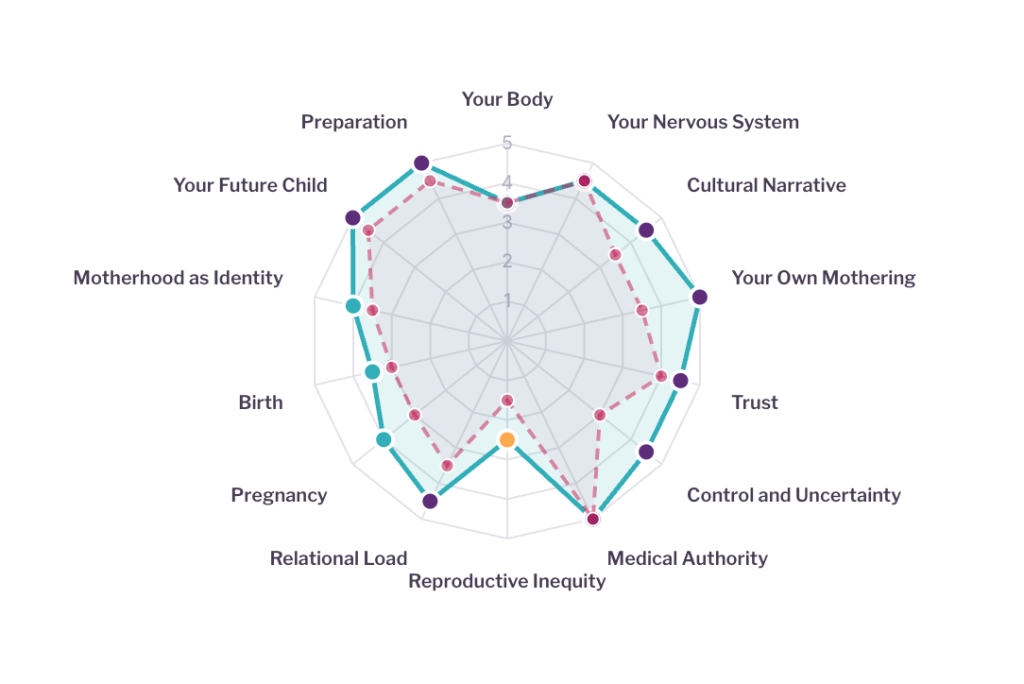
Thirteen of the fourteen dimensions moved. The fourteenth, Preparation, was already at the top of the scale before we began, so there was nowhere for it to go.
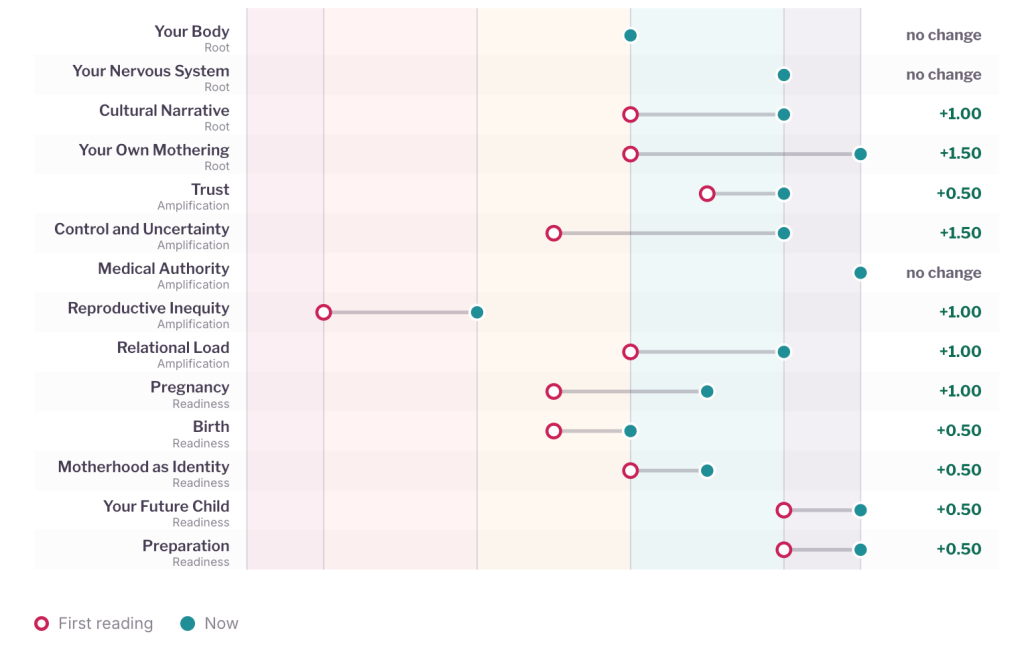
The two that moved furthest were her nervous system and her trust. Both by a level and a half on a five-level scale, which is more movement than I’d usually expect from three weeks.
Those are the same two areas that came back low at the start. The profile picked the target, we aimed the three weeks at it, and the profile then showed the target had moved. That’s it.
The nervous system reading is the one that needs a mention. She told me she was sitting at about a 2 out of 10 before she had any idea what the retake would show. And the assessment moved her further on that dimension than on almost anything else. Two separate things saying the same thing.
And Trust, the dimension that had been her weakest point going in, ended up level with her strongest. That one I did not see coming.
(The Profile is a structured self-assessment, not a clinical measure. It tracks how a woman describes her own inner readiness across those fourteen dimensions.)
What she did with it
Ellie didn’t finish the three weeks believing she could control the outcome of IVF. That was never the goal. What changed was her relationship with the whole thing.
She got through her egg collection without the spiral she’d have had in previous cycles. She held a small ceremony for her previous cycles and embryos and, in her words, felt “acknowledging everything which has happened so far, accepting it and realising it wasn’t anyone’s fault” rather than the grief she’d braced for. She stayed home to rest when she felt unwell, instead of panicking about whether it would derail the transfer.
She also gave her partner the book, and he used a clearance himself before a procedure he’d been anxious about.
Three sessions
You might have read that Ellie had three sessions earlier and made some assumptions as to what that means. Let me explain it with numbers, and it’s to do with the way that I work – a deliberate design decision on my part rather than a happy accident.
Conventional talking therapy tends to work one issue at a time, roughly a session a week. Ellie had three weekly sessions with me. In the time it takes to have three therapy sessions, she worked through 36 separate pieces of inner work: 25 clearances and 11 wound healings.
If each of those had been a single weekly session, that’s the best part of eight months of appointments.
She did it in three weeks, and most of it she did herself, with the tools and the recordings I gave her, at 3am when she couldn’t sleep and in the gaps between injections and scans.
That’s why I don’t work weekly. Women carrying reproductive fear are almost always on a timeline, and most of them don’t have eight months to spare. The resources carry the work between sessions so it compresses and results happen quickly. Not rushed. Just not dragged out.
What happened next
Two months have passed since we’ve worked together and Ellie has been through another cycle.
The biggest change she noticed came in the ten day wait. That’s the stretch after the transfer while you’re waiting for the pregnancy blood test, and anyone who has done it knows what it does to a person. Here’s how she described it:
“Normally I’d be wanting to do an at home test or checking in with my body to notice any different ‘signs’. This time I felt calmer and no need to have to know. I got on with work, enjoyed social catch ups and let each day happen.”
Ten days of not needing to know. After nine previous cycles of needing to know.
The transfer wasn’t successful. She found out on a Monday, and this is what she said about it:
“I feel tired and drained. There was a bit of sadness but mostly tiredness, followed by a feeling of wanting to do something which brings me joy and have a break from IVF.”
That is not a happy ending and I’m not going to present it as one. She didn’t get the baby. She’s tired. There was sadness.
What there wasn’t was collapse. There was no spiral, no grieving eight cycles at once, no bracing for the next round before she’d even finished this one. There was a tired woman who knew what she needed, which was a break and something that felt like living.
So she and her partner have decided to stop for six months and go travelling. They have a frozen embryo waiting and she’s in no hurry:
“I don’t feel a fear or pressure of my biological clock ticking. Instead I feel the need to focus on restoring my energy and doing something that’s awe-inspiring and going to connect me to the joy of living again. So when we do this next cycle I feel refreshed and connected with living.”
That’s a woman making a decision from choice rather than from fear, at 42, with a frozen embryo in storage. Six months ago she was mentally preparing for a life without children, just in case.
The part I didn’t expect
The thing she shared with me that I want to shine a light on is her relationship.
For the first four or five cycles, she said, having to explain and re-explain how she was feeling to her partner was one of the most draining parts of the whole thing. Hormones, uncertainty, and the same conversation over and over. In her words: surely he gets this by now????
These last two cycles she was still repeating herself. What changed was what happened inside her when she did:
“I didn’t get agitated or irritated. It was great not to have to deal with that on top of everything else. Instead I just found myself thinking ‘oh right, he’s forgotten about that’ and then say a simple sentence to explain what was happening during the cycle or how I was feeling.”
And then he changed too, without anyone asking him to. He started sharing more of how he was feeling, asking more questions, offering to do more.
That’s the bit nobody tells you about this work. She cleared her own head trash and her partner got easier to be married to. He didn’t do anything. The friction she’d been carrying into every one of those conversations simply wasn’t there any more, so the conversations went differently, so he responded differently.
Her own conclusion:
“I used to wonder how people could say IVF made them come closer as a couple. I understand now. This journey is about more than having a baby. It’s about living, whatever the outcome of IVF is. The healing I’ve done has helped me do this in a conscious way. It’s helped me resolve fears and see life in a broader way. I feel at peace with myself and whatever the outcome of IVF is.”
Why I’m sharing this
Repeated IVF doesn’t only ask something of the body. It asks an enormous amount of the nervous system. Hope, disappointment, waiting, grief, uncertainty, other people’s opinions, years of trying, all of it stacking up quietly until simply continuing feels like the hardest part.
Nobody hands you a way to put that down. The medical side of fertility treatment is well resourced and the emotional side just isn’t, and the women I speak to say the same thing Ellie did: it’s hard to talk about with the people closest to you, because they’re too close and they have their own feelings tangled up in it.
The work didn’t tell Ellie everything would be fine. It couldn’t, and as it turned out, cycle ten didn’t work either. What it did was help her put down years of accumulated weight, so that when the news came she had something left to meet it with. She’s tired rather than flattened. She’s taking a break because she chose to, not because she’s run out of road. And she’s at peace with an outcome she still doesn’t know.
If you’re somewhere in the middle of fertility treatment, I think that capacity is about the most useful thing there is to get back. It doesn’t change what happens. It changes what you’re carrying while you wait to find out. We can’t change what happens to us, but we can change how we respond to it.
If Ellie’s story sounds familiar, the gentlest first step is the free Tokophobia & Reproductive Anxiety Assessment. It’s the same family of assessment Ellie took, and it will give you a clearer picture of what you’re carrying at the moment. No cost, no pressure, and no obligation to do anything with it.
And if you’d rather just read for a while first, that’s completely fine. It’ll be here when you want it.